



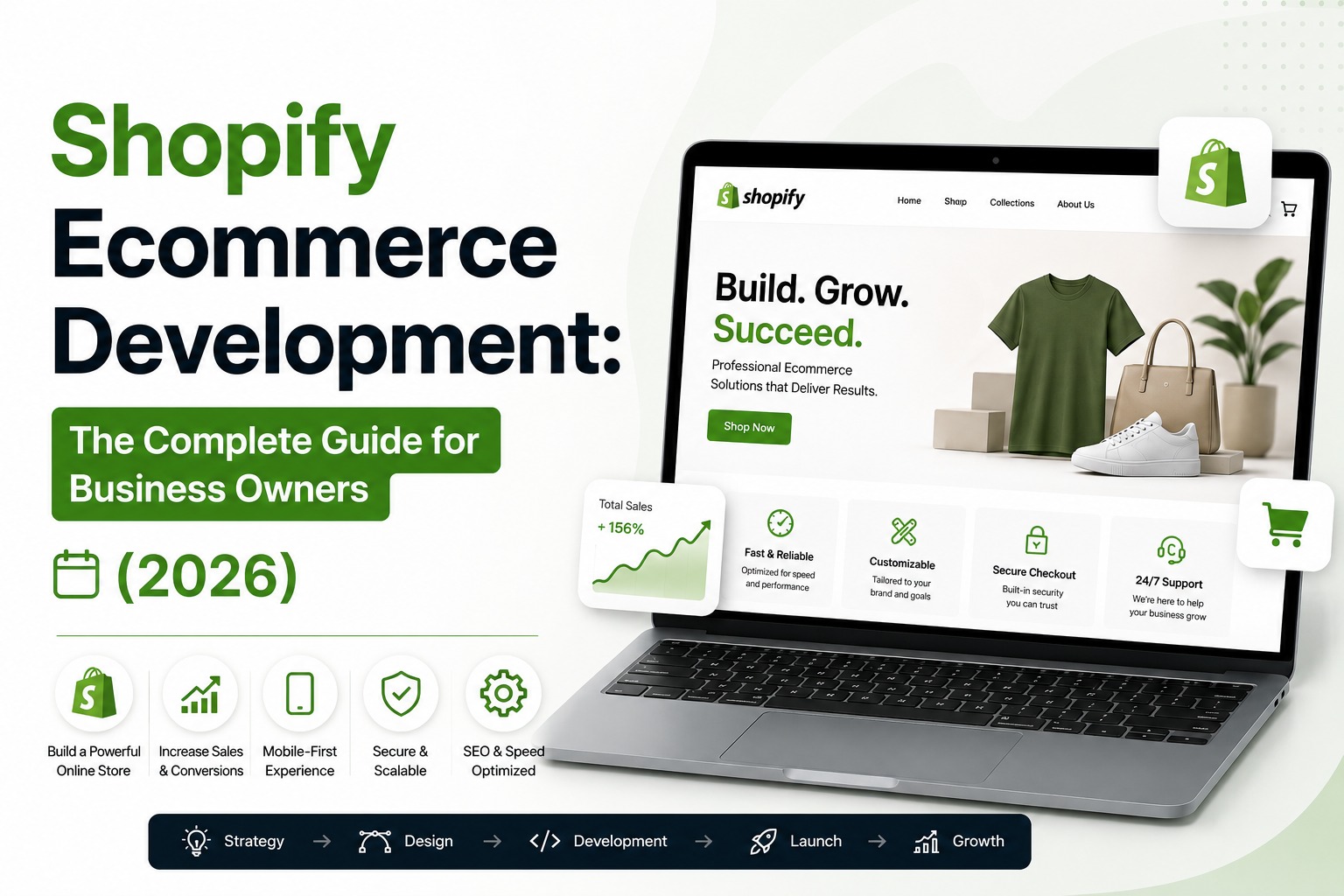
Is your online store built to convert — or just built to exist?
For business owners serious about growth, the platform you build on is one of the most consequential decisions you'll make. In 2026, the gap between businesses that thrive online and those that struggle is widening — and the difference often comes down to how well their ecommerce foundation is designed, developed, and optimised.
Shopify has emerged as the clear leader for a reason. It now powers over 5.6 million stores worldwide, commands 30% of the US ecommerce platform market, and processed over $292 billion in gross merchandise volume in 2024 alone. Enterprise brands like Estée Lauder, Gymshark, and Supreme have staked their digital futures on it. But choosing Shopify is just the first step
What separates a high-performing Shopify store from an average one isn't the platform itself — it's the quality of development behind it.This guide breaks down everything you need to know about Shopify ecommerce development: what it involves, why it matters, and how a professionally built store can become one of your most powerful revenue-generating assets.
Why Shopify Is the Platform of Choice for Ambitious Business OwnersBefore diving into development, it's worth understanding why Shopify consistently outperforms the competition — not just in market share, but in real merchant outcomes.
Proven Scale and StabilityShopify generated $11.5 billion in annual revenue in 2025, up 30% year-over-year. That level of investment flows directly back into the platform — faster checkout infrastructure, stronger security, deeper integrations, and a growing ecosystem of over 13,000 apps. When you build on Shopify, you're building on a foundation that won't become obsolete.
Designed for Growth at Every StageWhether you're launching your first store or scaling a multi-million-pound operation, Shopify grows with you. Its enterprise tier, Shopify Plus, now powers over 47,000 enterprise stores — a figure that grew 34% year-over-year — with brands migrating from legacy platforms like Magento and Salesforce Commerce Cloud specifically because of Shopify's lower total cost of ownership and faster time to market.
A Mobile-First RealityHere's a number every business owner should have front of mind: 79% of all Shopify traffic now comes from mobile devices, and mobile generates over 60% of sales. If your store isn't built with mobile performance as a priority, you are actively losing revenue every day. This isn't a trend. It's the baseline expectation.
What Professional Shopify Development Actually InvolvesMany business owners assume that launching on Shopify means choosing a template and populating it with products. That's how you build a store. It's not how you build a business.
Professional Shopify development is a strategic discipline that touches every layer of your customer's experience — from the first page load to the post-purchase follow-up.
Off-the-shelf themes have their place, but they're built for everyone, which means they're optimised for no one. A custom Shopify theme is architected around your specific products, your target customer's buying behaviour, and your brand identity.
The performance difference is significant. Top-performing Shopify stores achieve conversion rates of 3% to 5%, compared to the platform average of 1.4%. Much of that gap comes down to design quality, page speed, and how clearly the store guides visitors toward purchase. A professional development team builds with those outcomes in mind from the very first line of code.
Speed is a revenue lever, not a technical nicety. Research consistently shows that a one-second delay in page load time can meaningfully reduce conversions. On mobile — where the majority of your traffic arrives — slow pages are particularly damaging.
Expert Shopify developers optimise core web vitals, implement efficient image loading, minimise JavaScript bloat, and ensure your store performs at the highest level across all devices and connection speeds.
Your business has specific operational requirements that generic solutions won't address. Professional developers build custom Shopify apps and functionality to match your exact workflows — whether that means advanced product configurators, bespoke subscription models, loyalty programme integrations, or ERP and inventory system connections.
Shopify's app ecosystem generates over $890 million in annual developer revenue, reflecting the depth of what's possible when the platform is used to its full potential.
For businesses with complex requirements or a need for exceptional frontend performance, headless commerce represents the next evolution in Shopify development. The headless commerce market is expected to reach $11.8 billion by 2028, growing at a 17.5% CAGR.
In practical terms, headless separates your customer-facing storefront from Shopify's backend — giving your development team complete design freedom and delivering significantly faster, smoother experiences. Shopify's own Hydrogen and Oxygen frameworks are purpose-built for this approach, and they're maturing rapidly.
Building a store is the beginning of the work, not the end. Professional Shopify development includes ongoing optimisation — analysing where customers drop off, testing improvements to product pages, checkout flows, and calls to action, and iterating based on real data rather than assumptions.
The businesses that compound their growth are the ones that treat their store as a living asset, not a one-time project.
Business owners often approach Shopify development as a cost. The more accurate frame is return on investment.
Consider the economics: if your store currently converts at 1.4% and a professional development engagement moves that to 2.5%, you've nearly doubled your revenue from the same volume of traffic. That's not theoretical — it's the difference between a store that's functional and one that's genuinely built to perform.
The scope of a Shopify development project typically falls into three categories:Theme customisation — Adapting an existing Shopify theme with bespoke design elements, performance improvements, and targeted UX enhancements. Appropriate for businesses with clear brand guidelines and moderate technical requirements.
Custom theme development — Building a store from the ground up, designed around your customers' buying journey. Appropriate for businesses where brand experience is a competitive differentiator.
Full-scale Shopify Plus implementation — Enterprise-level builds with custom integrations, headless architecture, and ongoing development retainers. Appropriate for high-volume merchants and brands operating across multiple markets or channels.
The right scope depends on your current revenue, growth ambitions, and the complexity of your product catalogue and operations. A credible development partner will help you identify where investment generates the greatest return — not simply recommend the largest project.
Not all Shopify developers are equal. Before engaging a development partner, ask these questions:
What is your process for understanding our business before writing a single line of code? The best development work starts with strategy, not a design brief. Your developer should want to understand your customers, your margins, and your growth goals.
Can you share case studies with measurable results? Conversion rate improvements, revenue increases, page speed gains — a competent agency can point to specific, quantified outcomes from previous engagements.
How do you approach post-launch support and optimisation? A store launch is the beginning of a process. Understand what ongoing support looks like and how the relationship evolves after go-live.
Do you have Shopify Partner or Shopify Plus Partner status? This indicates a verified level of platform expertise and a direct relationship with Shopify's partner team.
How do you handle performance and core web vitals? Any serious Shopify developer should be able to speak fluently about page speed, Lighthouse scores, and mobile performance — and explain how they achieve them.
Understanding where Shopify is heading helps you make development decisions that remain relevant as the platform evolves.
AI-Powered Personalisation — 42% of Shopify merchants now use AI features including Sidekick and Magic. AI is increasingly embedded in how stores communicate with customers, personalise product recommendations, and automate marketing workflows.
Social Commerce Integration — The global social commerce market reached $821 billion in 2025, driven by TikTok, Instagram, and YouTube. Shopify's native integrations make it straightforward to sell directly through social channels, and forward-thinking development builds this into the store architecture from the start.
D2C Brand Expansion — Direct-to-consumer selling continues to grow as brands look to own the customer relationship, access first-party data, and protect their margins. Shopify is the platform of choice for this transition.
Omnichannel Retail — Shopify has invested significantly in bridging online and offline commerce. For businesses with physical retail operations, integrating in-store and online inventory, fulfilment, and customer data is increasingly achievable within a single Shopify ecosystem.
Before closing, it's worth being direct about the downside risk.
A poorly built Shopify store isn't just aesthetically underwhelming — it actively costs you money. Slow load times, confusing navigation, a cumbersome checkout flow, and inconsistent mobile experience all suppress conversion rates and erode customer trust. In a market where only 5 to 10% of Shopify stores are considered genuinely successful, the difference between that group and the rest is largely execution quality.
Beyond conversion rates, a poorly built store creates technical debt. Workarounds accumulate. Performance degrades. Integrations break. What initially seemed like a cost saving becomes an expensive rebuild eighteen months down the line.
The most commercially astute approach is to invest in quality development at the point of launch — and then continue investing in optimisation as your business grows.
The businesses winning on Shopify in 2026 are not the ones with the biggest marketing budgets. They're the ones with stores that are thoughtfully designed, technically excellent, and continuously improved.
If you're planning a new Shopify build, a migration from another platform, or a redevelopment of an underperforming store, the right development partner makes all the difference. The work we do is grounded in one goal: building Shopify stores that generate measurable, sustainable revenue growth for our clients.
Get in touch today to discuss your project. We'll start with a no-obligation conversation about your business, your current challenges, and what a high-performing Shopify store could realistically mean for your growth.
 Overall Rating:
4.8 out of
5 based on
174 User Rating
Overall Rating:
4.8 out of
5 based on
174 User Rating

.png)
.png)